
Special Education Teacher Jobs – Career Guide, Salary & Requirements
very child deserves an education that meets their unique needs. For millions of students with learning disabilities, autism, behavioral challenges, or physical impairments, the right teacher can change everything. Special education teacher jobs are not just careers—they are callings. These dedicated professionals help students who struggle in traditional classrooms to learn, grow, and succeed.
The demand for special education teachers is rising globally. Governments and schools are recognizing that inclusive education is not optional—it is essential. In the United States alone, thousands of special education positions go unfilled each year due to a shortage of qualified teachers. Similar shortages exist in the UK, Canada, Australia, and the Gulf countries.
This comprehensive guide covers everything you need to know about becoming a special education teacher. From qualifications and certifications to salary expectations and international opportunities, you will find all the information to start or advance your career in this rewarding field.
What Are Special Education Teacher Jobs?
Special education teacher jobs involve working with students who have physical, emotional, cognitive, or learning disabilities. These teachers adapt general education lessons to meet each student’s individual needs, as outlined in their Individualized Education Plan (IEP).
Special education teachers work in various settings:
- Public and private schools (inclusive classrooms or separate special education classrooms)
- Specialized schools for students with specific disabilities
- Early intervention programs (birth to age 3 or preschool)
- Rehabilitation centers and hospitals
- Residential facilities
- Online/virtual schools
Unlike general education teachers who teach a standard curriculum to a whole class, special education teachers personalize instruction. They may work one-on-one with a student, in small groups, or as a co-teacher in an inclusive classroom.
Key distinction:
- Special education teacher = certified professional who develops and implements IEPs
- Teaching assistant / paraprofessional = supports the special education teacher but does not design instruction
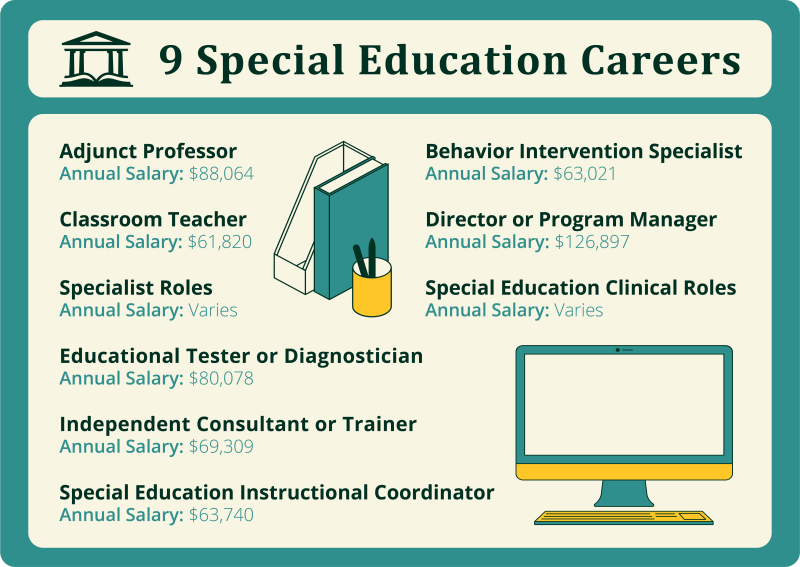
Role of a Special Education Teacher
The daily responsibilities of a special education teacher are diverse and demanding.
Assessment and evaluation:
- Identify students who may need special education services
- Administer academic, social, and behavioral assessments
- Collaborate with psychologists and therapists to interpret results
Individualized Education Plan (IEP) development:
- Write measurable annual goals for each student
- Determine appropriate accommodations and modifications
- Review and update IEPs annually (or more frequently)
- Ensure IEP implementation across all classes
Instruction and teaching:
- Adapt general education lessons to different learning levels
- Use specialized teaching methods (e.g., multisensory reading instruction)
- Teach basic skills: reading, writing, math, life skills, social skills
- Provide one-on-one or small group instruction
Behavioral support:
- Implement positive behavioral interventions
- Create behavior intervention plans (BIPs) for students with challenging behaviors
- De-escalate crises and maintain a safe classroom environment
Collaboration:
- Work with general education teachers to co-teach or provide accommodations
- Communicate with parents about progress and challenges
- Coordinate with speech therapists, occupational therapists, and school psychologists
- Attend IEP meetings and parent-teacher conferences
Documentation and compliance:
- Track student progress toward IEP goals
- Maintain legally required records
- Prepare reports for school districts and government agencies
Types of Special Education Teacher Jobs
Special education is a broad field. Here are the most common specializations.
| Type | Primary Focus | Work Setting | Typical Students |
|---|---|---|---|
| Learning Disabilities Teacher | Reading, writing, math difficulties | Resource room, inclusive classroom | Dyslexia, dyscalculia, dysgraphia |
| Autism Support Teacher | Social skills, communication, repetitive behaviors | Self-contained classroom, specialized school | Autism Spectrum Disorder (ASD) |
| Behavioral Support Teacher | Emotional regulation, impulse control, de-escalation | Alternative school, self-contained classroom | Emotional disturbance, ADHD, ODD |
| Inclusive Classroom Teacher | Co-teaching with general education teacher | General education classroom | Mild to moderate disabilities |
| Resource Room Teacher | Pull-out instruction for specific subjects | Resource room | Learning disabilities, mild disabilities |
| Early Intervention Teacher | Developmental delays in young children | Home visits, preschools, early childhood centers | Birth to age 5 with developmental delays |
| Online Special Education Teacher | Virtual instruction and accommodations | Remote / homeschool | Students who cannot attend in person |
Learning Disabilities Teacher
Focuses on students who struggle with reading (dyslexia), writing (dysgraphia), or math (dyscalculia). Uses specialized programs like Orton-Gillingham, Wilson Reading, or multisensory math.
Autism Support Teacher
Works with students on the autism spectrum. Teaches social communication, emotional regulation, and life skills alongside academics. Often uses visual schedules, social stories, and structured teaching methods (TEACCH).
Behavioral Support Teacher
Serves students with emotional disturbance, oppositional defiant disorder (ODD), attention deficit hyperactivity disorder (ADHD), or trauma histories. Implements behavior intervention plans (BIPs) and uses de-escalation techniques.
Inclusive Classroom Teacher
Co-teaches alongside a general education teacher. Ensures students with disabilities access the same curriculum with appropriate accommodations (extra time, modified assignments, assistive technology).
Resource Room Teacher
Pulls students out of the general education classroom for targeted instruction in reading, writing, or math. Students typically spend 20–60% of their day in the resource room.
Early Intervention Teacher
Works with infants and toddlers (birth to 3) or preschoolers (3–5) with developmental delays. Services are often provided in the child’s home or a community setting. Focuses on play-based, developmental activities.
Online Special Education Teacher
Provides virtual instruction and case management. Adapts digital materials, uses accessible technology, and coordinates with parents and general education teachers remotely.
Skills Required for Special Education Teachers
Special education teaching requires a unique combination of hard and soft skills.
Patience and empathy
Progress can be slow. A student may need 20 repetitions to learn what others learn in 2. You must celebrate small wins and remain calm during setbacks.
Communication skills
You explain complex concepts in simple language. You write clear IEP goals. You communicate sensitively with parents about their child’s challenges. You collaborate with therapists and administrators.
Classroom management
Students with behavioral challenges can disrupt learning. You need positive behavior strategies, crisis de-escalation techniques, and consistent routines.
Individualized Education Plan (IEP) knowledge
You must write legally compliant IEPs, track progress toward goals, and understand your legal responsibilities under IDEA (USA) or equivalent laws in your country.
Behavioral assessment skills
You observe and document behaviors, identify triggers and functions, and design behavior intervention plans (BIPs). Training in Functional Behavioral Assessment (FBA) is valuable.
Adaptability and creativity
What works for one student may fail for another. You constantly adjust materials, teaching methods, and classroom setups.
Collaboration skills
You work with general education teachers, parents, administrators, speech therapists, occupational therapists, and school psychologists. You must listen, compromise, and advocate.
Physical stamina
Some students require physical assistance (wheelchair transfer, positioning). Others may become physically agitated. You may need to stand, walk, or lift for much of the day.
Educational Requirements and Certifications
Requirements vary by country, but here is the general path.
Minimum requirement (most countries):
- Bachelor’s degree in special education (or general education + special education certification)
Common advanced qualifications:
- Master’s degree in special education (increases salary and promotion potential)
- Postgraduate certificate in special education (conversion for general education teachers)
- Board Certified Behavior Analyst (BCBA) – for autism and behavioral focus
Country-specific requirements:
| Country | Minimum Education | Certification / License | Additional Notes |
|---|---|---|---|
| United States | Bachelor’s degree | State teaching license + special education endorsement | Praxis exam required in most states |
| Canada | Bachelor’s of Education (B.Ed.) | Provincial teaching certificate | Special education additional qualification (AQ) course |
| United Kingdom | Bachelor’s degree + PGCE | Qualified Teacher Status (QTS) | NASENCO qualification for SEN coordinators |
| Australia | Bachelor’s of Education (Special Ed) | Teacher registration (state-based) | ACECQA approval for early intervention |
| UAE | Bachelor’s degree (minimum) | MOE teaching license + equivalency | 2+ years experience preferred |
| Saudi Arabia | Bachelor’s degree + teaching license | Ministry of Education approval | Experience in special education required |
| India | B.Ed. in Special Education (1–2 years) | RCI registration (Rehabilitation Council of India) | Mandatory for all special educators |
| Pakistan | B.Ed. / M.Ed. with special education | HEC approved degree | No national license (varies by province) |
| Philippines | Bachelor’s in Special Education | PRC license (LET passer) | Additional SPED certification |
Key certifications to boost your career:
- USA: Board Certified Behavior Analyst (BCBA), Autism Certificate, Orton-Gillingham (reading)
- UK: National Award for SEN Coordination (NASENCO)
- International: International Board of Credentialing and Continuing Education Standards (IBCCES) – Autism certification
How to Become a Special Education Teacher Step-by-Step
Follow this roadmap:
Step 1: Earn a bachelor’s degree
Major in special education directly, or major in general education with a special education concentration. Ensure your program is accredited and leads to licensure.
Step 2: Complete student teaching (practicum)
Most programs require 10–20 weeks of supervised teaching in a special education classroom. This is your most valuable experience.
Step 3: Pass required exams
- USA: Praxis Special Education exam (or state-specific tests)
- UK: Professional Skills Tests (before QTS)
- India: RCI licensing exam
- Philippines: Licensure Examination for Teachers (LET) with SPED specialization
Step 4: Apply for teaching license / certification
Submit transcripts, test scores, background check, and student teaching verification to your country’s education authority.
Step 5: Gain experience (1–3 years)
Entry-level positions in public schools, private special education schools, or early intervention programs. Many teachers start as teaching assistants while completing certification.
Step 6: Pursue master’s degree (optional but recommended)
A master’s in special education increases salary (often required for permanent positions in some countries) and opens leadership roles.
Step 7: Obtain advanced certifications
BCBA for behavior focus, Orton-Gillingham for reading, TESOL for English language learners with disabilities.
Step 8: Apply for international positions (if desired)
After 2–3 years of experience, you are eligible for special education jobs in the Gulf, Asia, or international schools worldwide.
Training Programs and Special Education Courses
If you are already a general education teacher, you can transition to special education through certificate programs.
Short courses (4–12 weeks, online/in-person):
- Teaching Students with Autism (many universities)
- Behavior Management in the Classroom
- Differentiated Instruction
- Introduction to IEP Writing
Certificate programs (6–12 months):
- Postgraduate Certificate in Special Education (many UK/Australian universities online)
- Special Education Endorsement (US state programs)
Degree programs:
- Bachelor of Education in Special Education (4 years)
- Master of Arts in Special Education (1.5–2 years)
- Master of Education in Special Education (1.5–2 years)
Online course providers:
- Coursera: “Disability Inclusion in Education” (University of Cape Town)
- edX: “Special Education Professional Certificate” (University of Washington)
- FutureLearn: “Supporting Children with Special Educational Needs” (University of Birmingham)
Cost: Free to $5,000 depending on program length and institution.
Recruitment Process for Special Education Jobs
The hiring process varies but generally follows these stages:
1. Job advertisement
Posted on school district websites, government portals, Indeed, LinkedIn, or special education job boards.
2. Application submission
CV, cover letter, teaching license copy, transcripts, references (2–3).
3. Initial screening (HR)
Phone or video call to verify qualifications, salary expectations, and availability.
4. Interview with special education director or principal
Questions about IEP experience, behavior management, collaboration with parents, and specific disabilities you have worked with.
5. Teaching demonstration (sometimes)
You may be asked to teach a 15–20 minute lesson to a small group of students with disabilities (current students or role-playing staff).
6. Reference checks
Your former supervisors are contacted.
7. Background check and fingerprinting
Mandatory for working with children.
8. Job offer and contract signing
Timeline: 4–12 weeks for public schools; 2–6 weeks for private/contract positions.
Interview Questions and Preparation Tips
Common interview questions:
- “Why do you want to work in special education?”
- “Describe your experience writing and implementing IEPs.”
- “How do you handle a student who is having a meltdown?”
- “How do you collaborate with general education teachers?”
- “Describe a time you helped a student make significant progress.”
- “How do you communicate with parents who are resistant to special education services?”
- “What behavior management strategies do you use?”
- “How do you differentiate instruction for students at different levels?”
- “What is your experience with assistive technology?”
- “How do you manage paperwork and documentation deadlines?”
Sample answer (Question 3 – meltdown):
“First, I ensure safety. I clear the area of other students and objects. Then I speak calmly, using simple statements like ‘I see you are upset.’ I avoid demands during the peak of the meltdown. Once the student begins to calm, I offer choices: ‘Would you like water or to sit in the calm corner?’ Afterward, I debrief with the student and document the incident. I also review the behavior intervention plan to see if triggers can be avoided or supports added.”
Preparation tips:
- Bring a portfolio with sample IEPs (redacted to remove student names), behavior plans, and lesson plans.
- Research the school’s special education model (inclusive vs. self-contained).
- Be ready to discuss specific disabilities you have experience with (autism, learning disabilities, emotional disturbance, etc.).
- Prepare questions to ask: “What is the caseload size?” “What paraprofessional support is available?” “What professional development is offered?”
Salary of Special Education Teachers by Country
Salaries vary by country, experience, qualifications (master’s degree vs. bachelor’s), and setting (public vs. private).
All figures are annual gross salary in USD before taxes.
| Country | Entry Level (0–2 years) | Mid-Career (5–8 years) | Senior (10+ years) |
|---|---|---|---|
| United States | $40,000 – $50,000 | $50,000 – $65,000 | $65,000 – $85,000+ |
| Canada | $45,000 – $60,000 (CAD) | $60,000 – $80,000 (CAD) | $80,000 – $100,000 (CAD) |
| United Kingdom | £25,000 – £32,000 | £32,000 – £45,000 | £45,000 – £60,000+ |
| Australia | AUD 65,000 – 80,000 | AUD 80,000 – 100,000 | AUD 100,000 – 125,000+ |
| UAE | $36,000 – $48,000 (tax-free) | $48,000 – $66,000 (tax-free) | $66,000 – $90,000+ (tax-free) |
| Saudi Arabia | $30,000 – $45,000 (tax-free) | $45,000 – $60,000 (tax-free) | $60,000 – $85,000+ (tax-free) |
| India (private) | $3,600 – $6,000 | $6,000 – $12,000 | $12,000 – $18,000 |
| India (government) | $6,000 – $8,000 | $8,000 – $12,000 | $12,000 – $18,000 |
| Philippines (public) | $4,000 – $6,000 | $6,000 – $9,000 | $9,000 – $15,000 |
Additional benefits (especially international/Gulf):
- Free housing or housing allowance ($10,000–$20,000/year)
- Annual flight tickets home
- Health insurance (including family)
- Children’s tuition (up to $8,000–$15,000 per child)
- End-of-service bonus (1 month salary per year worked)
- Signing bonus (rare, but offered for hard-to-fill positions)
US signing bonuses: Some US school districts offer $5,000–$15,000 signing bonuses for special education teachers due to shortages.
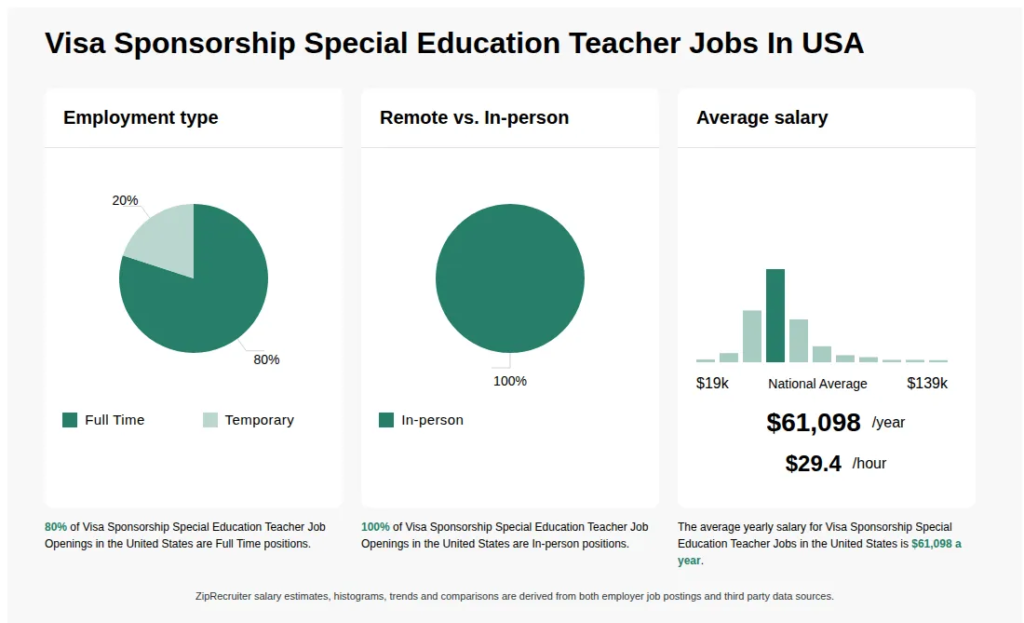
Government Special Education Teacher Jobs
Government (public school) special education jobs offer job security, pensions, and union protections.
United States:
- Hired by public school districts (K-12)
- Salary determined by collective bargaining agreements (based on education + years of experience)
- Strong unions (NEA, AFT)
- Pension system (e.g., CalSTRS, TRS) – retire after 30 years with 60–80% of salary
- Health benefits for life (after retirement, in some states)
Canada:
- Public school boards hire special education teachers
- Ontario, British Columbia, Alberta have highest salaries
- Strong teachers’ unions
- Defined benefit pension plan
United Kingdom:
- Local Education Authorities (LEAs) hire for community schools
- National pay scales (Main Pay Scale for classroom teachers, Upper Pay Scale for experienced)
- Teachers’ Pension Scheme (defined benefit)
India:
- Kendriya Vidyalaya Sangathan (KVS), Navodaya Vidyalaya Samiti (NVS), state government schools
- Recruited through central or state exams (KVS, DSSSB, UPTET, etc.)
- 7th Pay Commission scales (Level 7 or 8: ₹44,900–₹1,42,400/month)
- Lifetime pension (old pension scheme for hires before 2004; new scheme for later hires)
How to find government special education jobs:
- USA: School district websites (search “special education teacher”)
- UK: Teaching Vacancies service (gov.uk/teaching-vacancies)
- Canada: Apply to Education (applytoeducation.com)
- India: KVS, DSSSB, state TET exams
Private School Special Education Jobs
Private schools offer smaller class sizes, more resources, and faster hiring, but typically lower pay and fewer benefits than public schools (in the US/Canada). In developing countries, private schools often pay higher than government.
Advantages:
- Smaller caseloads (5–10 students vs. 15–25 in public schools)
- More support staff (paraprofessionals, therapists)
- Specialized student population (e.g., only students with autism)
- Faster hiring process (2–6 weeks)
- No union dues (pro or con depending on perspective)
Disadvantages:
- Lower salary (in US: $5,000–$15,000 less than public)
- No pension (only 401k or similar)
- Less job security (can be non-renewed without cause)
- May require longer hours (some have afterschool programs)
Types of private special education schools:
- Independent special education day schools (e.g., The Gateway School, Landmark School)
- Residential treatment centers (students live on campus)
- Therapeutic day schools (combined academics + therapy)
How to find private school jobs:
- NAIS Career Center (National Association of Independent Schools)
- Indeed.com (filter by “special education private school”)
- Directly on school websites
NGO and Rehabilitation Center Jobs
Non-governmental organizations (NGOs) and rehabilitation centers hire special education teachers for community-based programs.
Work settings:
- Early intervention centers (e.g., The Arc, Easterseals – USA)
- Disability-focused NGOs (e.g., Special Olympics, Autism Speaks)
- Rehabilitation hospitals (e.g., Craig Hospital, Kennedy Krieger Institute)
- Community mental health centers
Typical roles:
- Early intervention specialist (home visits)
- Vocational training teacher (teaching job skills to young adults with disabilities)
- Hospital school teacher (for children receiving long-term medical care)
- Community integration teacher (life skills, social outings)
Salaries:
- Often lower than school-based positions (funded by grants and donations)
- $25,000–$45,000 in the US
- $15,000–$30,000 internationally
How to find NGO jobs:
- Idealist.org (global)
- ReliefWeb (for humanitarian roles)
- Directly on NGO websites (Easterseals, Special Olympics, etc.)
Online Special Education Teaching Opportunities
Remote special education teaching has grown significantly since 2020.
Where online special education teachers work:
- Full-time online public schools (e.g., K12 Inc., Connections Academy, Stride)
- Virtual private schools
- Homeschool cooperatives (provide services to homeschooling families)
- Tutoring platforms specializing in learning disabilities (e.g., TutorMe, Varsity Tutors – SPED focus)
Responsibilities:
- Provide live or recorded instruction via Zoom/Teams
- Adapt digital materials (accessible PDFs, screen readers)
- Conduct virtual IEP meetings
- Coordinate with parents and general education teachers
- Document progress in online systems
Technology requirements:
- Reliable internet, webcam, microphone
- Familiarity with learning management systems (Canvas, Blackboard, Schoology)
- Assistive technology (text-to-speech, speech-to-text)
Salary:
- Full-time online: $40,000–$60,000 (similar to in-person, sometimes lower)
- Part-time tutoring: $25–$50 per hour
How to find online special education jobs:
- K12.com/careers
- ConnectionsAcademy.com/careers
- FlexJobs.com (filter by “special education remote”)
- Indeed.com (search “remote special education teacher”)
Licensing requirement: Most online schools require a valid teaching license in the state where the student resides (for US positions).
Special Education Jobs for Fresh Graduates
Can you become a special education teacher immediately after graduation? Yes, but often with conditions.
Entry-level options for fresh graduates:
Teaching assistant / paraprofessional:
- Work alongside a certified special education teacher
- Gain hands-on experience while earning certification (or while applying for teaching roles)
- Pay: $20,000–$30,000 (US)
Resident teacher / intern (USA):
- Alternative certification programs (e.g., Teach for America, TNTP)
- You teach full-time while completing coursework for licensure
- Pay: Standard teacher salary (reduced first year sometimes)
Special education teacher in high-need districts:
- Rural areas, urban districts, or districts with severe shortages will hire uncertified teachers on provisional licenses
- You must complete certification within 2–3 years
Private special education schools (developing countries):
- Some private schools in India, Pakistan, Philippines hire fresh graduates with a B.Ed. in Special Education
- Pay is lower ($200–$500/month) but you gain experience
How fresh graduates can be competitive:
- Complete additional certifications (e.g., ABA training, Orton-Gillingham associate level)
- Volunteer or intern during college (summer camps for children with disabilities)
- Create a portfolio with sample IEPs and lesson plans (from student teaching)
- Be willing to relocate to underserved areas
Career Growth and Promotion Opportunities
Special education teaching offers several advancement paths.
| Role | Typical Experience | Responsibilities | Salary Increase |
|---|---|---|---|
| Special Education Teacher | 0–5 years | Classroom instruction, IEPs | Base salary |
| Lead Special Education Teacher | 5–8 years | Mentor new teachers, coordinate grade-level IEPs | +5–15% |
| Special Education Department Chair | 8–12 years | Supervise special ed teachers, manage budget, compliance | +10–20% |
| Instructional Coach (Special Ed) | 8–12 years | Train teachers, model lessons, observe classrooms | +10–20% |
| Special Education Coordinator | 10–15 years | Oversee all special education programs for a school or district | +20–35% |
| Director of Special Education | 15–20 years | District-wide leadership, policy, legal compliance, budgeting | +50–100% |
| Professor of Special Education (PhD) | 15+ years | Teach future special education teachers, conduct research | $70,000–$120,000+ |
How to get promoted:
- Earn a master’s degree (often required for coordinator/director roles)
- Obtain administrative certification (principal or special education director license)
- Demonstrate results (student growth data, successful IEP audits)
- Take on leadership roles (union representative, committee chair)
- Pursue National Board Certification (USA – adds 5–15% salary bump in many states)
Challenges in Special Education Teaching
Special education is deeply rewarding but also uniquely challenging.
High caseloads
Some special education teachers manage 20–30 students across multiple grade levels. Writing and tracking that many IEPs is overwhelming.
Behavioral crises
Physical aggression, self-injurious behavior, elopement (running away). You need crisis prevention training (CPI, TCI, or similar).
Paperwork burden
IEPs, progress reports, behavior data sheets, Medicaid billing (in some states), re-evaluation reports. Paperwork often takes 10–15 hours per week outside teaching hours.
Parent communication difficulties
Some parents are in denial about their child’s disability. Others are angry about services. Balancing empathy with legal requirements is delicate.
Burnout and turnover
Special education teachers leave the field at twice the rate of general education teachers. Causes: stress, low pay relative to workload, lack of administrative support.
Physical demands
Lifting students, transferring wheelchairs, positioning, standing for long periods, and occasional physical restraint (in crisis situations).
Legal liability
IEPs are legal documents. Failure to implement an IEP can result in due process hearings or lawsuits. The pressure is real.
Isolation
In some schools, special education teachers are physically separated from general education staff. Collaboration may be limited.
Benefits of Working as a Special Education Teacher
Despite the challenges, the rewards are significant.
Making a measurable difference
You teach a child to read their first word. You help a student with autism make a friend. You prevent a student from being placed in a more restrictive setting. These wins are profound.
Job security
Special education teachers are in chronic shortage globally. You will almost always find a job. Layoffs affect general education first.
Smaller class sizes
While caseloads can be high, direct instruction often occurs in groups of 3–8 students. You build deep relationships.
Summer and holiday breaks
Like all teachers, you have 10–12 weeks off per year (paid, in salaried positions).
Pension and benefits
Public school special education teachers (in many countries) receive excellent retirement benefits and health insurance.
Loan forgiveness (USA)
Special education teachers may qualify for Public Service Loan Forgiveness (PSLF) and Teacher Loan Forgiveness (up to $17,500).
Continuous learning
You will attend conferences, earn certifications, and stay current on evidence-based practices. Your professional skills grow throughout your career.
Advocacy opportunities
You become a voice for students with disabilities, advocating for inclusive policies and adequate resources.
International Opportunities for Special Education Teachers
Special education teachers are in demand worldwide, especially in countries building inclusive education systems.
Best international destinations:
United Arab Emirates (Dubai, Abu Dhabi, Sharjah)
- Tax-free salaries $40,000–$90,000
- Free housing or allowance, flights, health insurance, tuition for children
- High demand for autism and early intervention specialists
- Requirements: Bachelor’s + 2 years experience + teaching license
Saudi Arabia
- Tax-free salaries $35,000–$80,000
- Similar benefits to UAE (housing, flights, etc.)
- Gender-segregated schools (female teachers for female students)
- Requirements: 2+ years experience, bachelor’s, teaching license
Qatar
- Salaries similar to UAE
- Growing special education sector (new laws on inclusive education)
- Supreme Education Council oversees recruitment
China
- International schools hiring special education teachers (learning support roles)
- Salaries $35,000–$60,000 + housing
- Higher demand in Shanghai, Beijing, Guangzhou
Southeast Asia (Thailand, Vietnam, Malaysia)
- Lower salaries ($20,000–$40,000) but lower cost of living
- International schools with inclusive programs
- Good for early career or semi-retired teachers
How to find international special education jobs:
- Search Associates (searchassociates.com)
- ISS (iss.edu)
- TES.com (international jobs)
- Schrole (schrole.com)
- Directly on international school websites
How to Find Special Education Teacher Jobs Online
Use these job boards regularly:
General education job boards:
- Indeed.com (filter by “special education”)
- LinkedIn (set job alert for “special education teacher”)
- Glassdoor.com
- SimplyHired.com
Special education focused:
- SpecialEdCareers.com (USA)
- SEN Jobs (UK) – sendirect.org.uk
- Council for Exceptional Children (CEC) Career Center – exceptionalchildren.org/careers
Government portals (USA):
- USAJobs.gov (federal positions – military base schools, Bureau of Indian Education)
- SchoolSpring.com (state-by-state)
Government portals (other countries):
- UK: teaching-vacancies.service.gov.uk
- Canada: applytoeducation.com (Ontario) / makeafuture.ca (British Columbia)
- Australia: teacherjobs.net.au / SmartJobs.qld.gov.au (Queensland)
- India: KVS – kvsangathan.nic.in, DSSSB – dsssb.delhi.gov.in
International school job boards:
- Search Associates
- ISS (International Schools Services)
- TES International (timeshighereducation.com)
NGO and nonprofit:
Pro tip: Set up email alerts on 3–5 boards. New jobs are posted daily. Apply within 48 hours for best response rates.
Frequently Asked Questions (FAQ)
1. Do I need a special education degree to work as a special education teacher?
In most countries, yes. Some alternative certification programs allow general education teachers to earn special education credentials while teaching. However, a bachelor’s in special education is the most direct path.
2. Can I become a special education teacher without a teaching license?
Some private schools hire unlicensed special education teachers. Public schools almost always require a license. Internationally, some countries hire unlicensed teachers but require experience.
3. What is the difference between an IEP and a 504 plan (USA)?
An IEP provides specialized instruction and services for students with disabilities that impact learning. A 504 plan provides accommodations (e.g., extra time, preferential seating) but not specialized instruction. Special education teachers write IEPs; 504 plans are typically managed by general education counselors.
4. Which disability category has the highest demand for teachers?
Autism (ASD) and emotional/behavioral disorders (EBD) currently have the highest demand. Many school districts specifically seek teachers with experience in these areas.
5. Can I teach special education online?
Yes. Full-time online public schools and virtual academies hire special education teachers for remote IEP management and instruction. Part-time online tutoring for students with learning disabilities is also growing.
6. What is the hardest part of being a special education teacher?
The paperwork volume is the most commonly cited frustration. Many special education teachers spend 10–20 hours per week on IEPs, progress reports, and documentation outside contract hours.
7. Do special education teachers get paid more than general education teachers?
In most public school systems, special education teachers are paid the same base salary as general education teachers (same experience + education level). However, some districts offer a stipend ($2,000–$5,000) or higher starting salary for special education due to shortages.
8. What is the job outlook for special education teachers?
Excellent. The US Bureau of Labor Statistics projects 4% growth (average) but actual demand in many districts is much higher due to turnover and shortages. The UK, Australia, and Canada also report chronic shortages.
9. Can I work as a special education teacher abroad with a US license?
Yes, if your license is valid. Many international schools prefer US, UK, Canadian, Australian, or New Zealand certified teachers. You may need to have your degree and license attested by the host country’s embassy.
10. How do I handle aggressive behavior from students?
You should never handle it alone. Most schools require training in Crisis Prevention Institute (CPI) or Therapeutic Crisis Intervention (TCI) techniques. These focus on de-escalation before physical intervention. Only use restraint as a last resort and according to your school’s policy. Always document and report.

Key Takeaways
- Special education teacher jobs are in high demand globally due to chronic shortages and growing awareness of inclusive education.
- Minimum qualification is a bachelor’s degree in special education (or general education + special education certification). A master’s degree increases salary and promotion potential.
- Highest paying countries for special education teachers are the United States, Canada, Australia, UAE, and Saudi Arabia (tax-free in Gulf).
- Specializations with highest demand: autism support, behavioral support, and early intervention.
- Key skills include patience, IEP writing, behavior management, collaboration, and adaptability.
- Public school special education jobs offer the best job security, pension, and benefits. Private and international schools offer faster hiring and sometimes higher pay (Gulf).
- International opportunities are excellent after 2–3 years of experience. Gulf countries offer tax-free salaries + housing + flights.
- Challenges include high caseloads, paperwork burden, behavioral crises, and burnout. Self-care and strong administrative support are essential.
- Career growth can lead to department chair, instructional coach, coordinator, director, or professor roles (with PhD).
- Job search should include general boards (Indeed, LinkedIn), special education boards (CEC Career Center, SpecialEdCareers), government portals, and international school recruiters.
Conclusion
Special education teacher jobs are among the most important, challenging, and rewarding roles in education. You do not just teach academics. You teach a child with dyslexia that they are smart. You teach a child with autism that they belong. You teach a child with emotional trauma that adults can be trusted.
The path is not easy. The qualifications are rigorous: a degree, certification, and often a master’s. The daily work involves paperwork, behavior crises, and collaboration with resistant parents. Burnout is real. Turnover is high.
But for those who persist, the rewards are unmatched. You will see progress that others said was impossible. You will be the teacher a student remembers for life. You will have job security in a field that desperately needs you. And you will earn a solid, living-wage salary with excellent benefits (especially in public systems).
If you are patient, compassionate, resilient, and committed to inclusion, the world needs you as a special education teacher. Start by researching accredited programs in your country. Volunteer in a special education classroom. Earn your degree and certification. Then apply to the hundreds of open positions waiting for a qualified, caring professional like you.
Explore current special education teacher vacancies on the job boards listed above. Your students are waiting.