
Supreme Court Jobs in Pakistan
Supreme Court of Pakistan jobs are prestigious career opportunities within the country’s apex judiciary. The court offers stable employment, competitive government pay scales, and the chance to contribute to the administration of justice. This guide provides a complete overview of current job opportunities, eligibility criteria, and application procedures for Supreme Court positions.

Overview of Supreme Court Employment
The Supreme Court of Pakistan (SCP) regularly announces vacancies for various administrative and support staff positions. Recruitment is often conducted through third-party testing agencies like the National Testing Service (NTS) or the Open Testing Service (OTS) to ensure transparency . The department makes appointments strictly on merit, as well as on regional and other quota bases .
In recent months, the Supreme Court has also made several senior-level administrative appointments to enhance institutional efficiency and advance reforms, particularly through a reshuffle of top registrar and director-level posts .
Current Job Openings by Position
Administrative and Clerical Positions
The Supreme Court has recently advertised numerous vacancies through NTS across a wide range of pay scales .
BPS-16 Positions:
- Judicial Assistant (04 posts): Requires a Bachelor’s degree. Domicile quotas apply across provinces including Punjab/Islamabad, Sindh (Urban), Khyber Pakhtunkhwa, and Balochistan .
- Assistant Private Secretary (06 posts): Candidates must have a Bachelor’s degree and shorthand/typing skills. Positions are allocated under merit, Punjab/Islamabad (with a minority quota), Sindh (Urban), and Khyber Pakhtunkhwa (woman quota) .
BPS-14 Positions:
- Protocol Assistant (06 posts): Domicile quotas apply across Punjab/Islamabad, Sindh (Rural & Urban), Khyber Pakhtunkhwa, and Balochistan .
- Stenotypist (06 posts): Requires shorthand and typing proficiency. Domicile quotas cover Punjab/Islamabad, Sindh (Urban), Balochistan, and Gilgit Baltistan/FATA .
- Accounts Assistant (01 post): Reserved for Sindh (Urban) domicile holders .
BPS-09 to BPS-07 Positions:
- Library Clerk (BPS-09, 03 posts): Punjab/Islamabad (02 posts) and Khyber Pakhtunkhwa (01 post) .
- Lower Division Clerk (LDC) (BPS-07, 10 posts): Wide quota distribution across Punjab/Islamabad, Sindh (Rural & Urban), Khyber Pakhtunkhwa, Balochistan, and Gilgit Baltistan/FATA .
BPS-05 and Below:
- Driver (BPS-05, 14 posts): Merit and provincial quotas including Punjab/Islamabad, Sindh (Urban & Rural), Khyber Pakhtunkhwa, and Balochistan .
- Cook (BPS-03, 01 post): Merit-based appointment .
- Naib Qasid (BPS-03, 38 posts): Merit, Punjab/Islamabad (with woman and minority quotas), Sindh (Urban & Rural), Khyber Pakhtunkhwa, Balochistan, Gilgit-Baltistan/FATA, and Azad Jammu and Kashmir .
Senior Administrative Appointments
In late 2025 and early 2026, the Supreme Court made several key high-level appointments to strengthen its administrative framework .
| Position | BS Scale | Appointee | Source |
|---|---|---|---|
| Registrar | BS-22 | Sohail Mohammad Laghari | |
| Director General (Reforms) | BS-22 | Fakhar Zaman | |
| Secretary, Supreme Judicial Council | BS-22 | Abid Rizwan Abid | |
| Additional Registrar (Judicial) | BS-21 | Muhammad Abbas Zaidi | |
| Additional Registrar (Karachi) | BS-21 | Zulfikar Ahmed | |
| Additional Registrar (Lahore) | BS-21 | Mohammad Safdar Mehmood | |
| Additional Registrar (Peshawar) | BS-21 | Mujahid Mehmood | |
| Additional Registrar | BS-21 | Fawad Ahmad | |
| Additional Registrar (Administration) | BS-21 | Sohail Ahmad | |
| Director IT | BS-20 | Sohail Ahmed |
How to Apply
Application Process
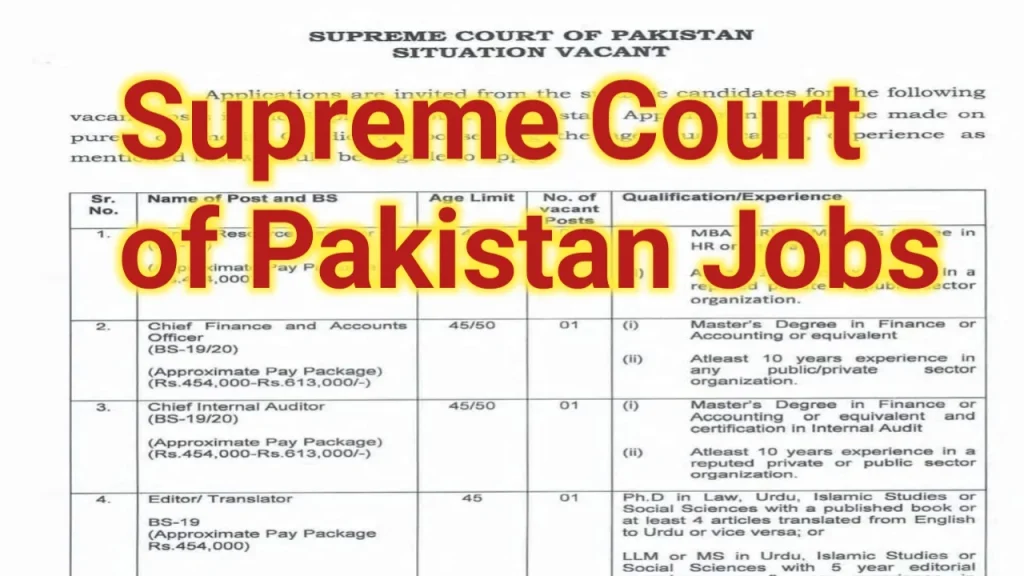
Applications for Supreme Court jobs are typically submitted online through the official testing service portals .
- Identify the Advertisement: Regularly check the official Supreme Court website (
www.supremecourt.gov.pk) and major newspapers for job announcements . - Check Eligibility: Ensure you meet the required qualification, age limit, experience, and domicile criteria for the specific post .
- Apply Online: Submit your application through the designated portal (e.g.,
www.ots.org.pkorwww.nts.org.pk) within the advertised deadline . An application processing fee is typically required. - Wait for Test/Interview: Shortlisted candidates will be called for a written test and/or interview conducted by the testing service. For senior-level appointments on deputation, the process may be handled directly by the court’s administration .
Required Documents
Candidates must prepare attested copies of the following documents:
- Educational certificates and degrees
- CNIC (Computerized National Identity Card)
- Domicile certificate
- Recent passport-size photographs
- Experience certificates (if applicable)
- NOC (No Objection Certificate) for government employees, if required
Frequently Asked Questions (FAQs)
1. How can I find current job vacancies in the Supreme Court of Pakistan?
The best way to stay informed is to regularly visit the official website of the Supreme Court of Pakistan at www.supremecourt.gov.pk . Vacancies are also advertised in national newspapers and on the portals of testing agencies like NTS and OTS .
2. What is the typical application process for Supreme Court jobs?
Most vacancies are handled by an external testing service like NTS or OTS. You must apply online through the respective service’s portal (e.g., www.ots.org.pk) and submit an application processing fee. The selection process usually involves a written test and an interview .
3. Are Supreme Court jobs only for people with law degrees?
No, the Supreme Court employs a wide range of administrative and support staff who do not have legal backgrounds. Vacancies exist for positions like accounts assistants, library clerks, LDCs, drivers, and Naib Qasids, which require qualifications from Bachelor’s degrees to Primary school education .
4. What are the eligibility criteria for Supreme Court jobs?
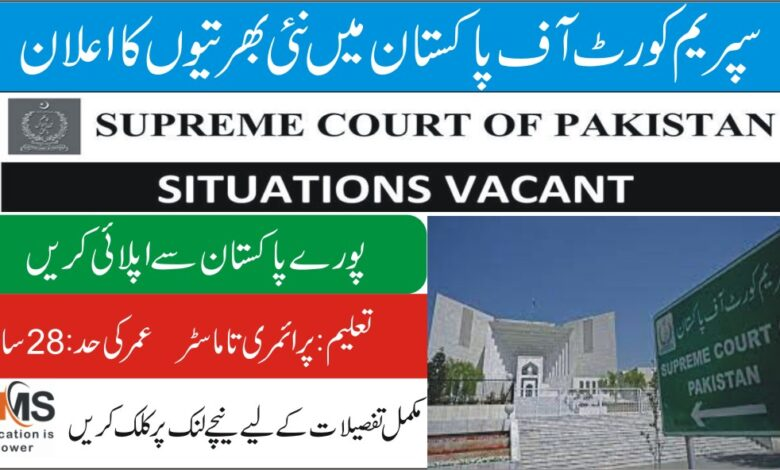
Eligibility criteria vary by position. They include a specific educational qualification (e.g., Bachelor’s for Judicial Assistant), age limit (e.g., 25-28 years for some roles ), and a valid domicile from a specific province or region, as per the quota system .
5. Are there separate quotas for different provinces and minorities?
Yes, the Supreme Court of Pakistan strictly adheres to a quota system. Vacancies are allocated on a provincial basis (Punjab/Islamabad, Sindh, Khyber Pakhtunkhwa, Balochistan) and also include quotas for women, minorities, and candidates from Gilgit Baltistan/FATA and Azad Jammu and Kashmir .